The greatest weight. — What, if some day or night a demon were to steal after you into your loneliest loneliness and say to you: “This life as you now live it and have lived it, you will have to live once more and innumerable times more; and there will be nothing new in it, but every pain and every joy and every thought and sigh and everything unutterably small or great in your life will have to return to you, all in the same succession and sequence even this spider and this moonlight between the trees, and even this moment and I myself. The eternal hourglass of existence is turned upside down again and again, and you with it, speck of dust!”

Would you not throw yourself down and gnash your teeth and curse the demon who spoke thus? Or have you once experienced a tremendous moment when you would have answered him: “You are a god and never have I heard anything more divine.” If this thought gained possession of you, it would change you as you are or perhaps crush you. The question in each and every thing, “Do you desire this once more and innumerable times more?” would lie upon your actions as the greatest weight. Or how well disposed would you have to become to yourself and to life to crave nothing more fervently than this ultimate eternal confirmation and seal? — The Gay Science by Friedrich Nietzsche
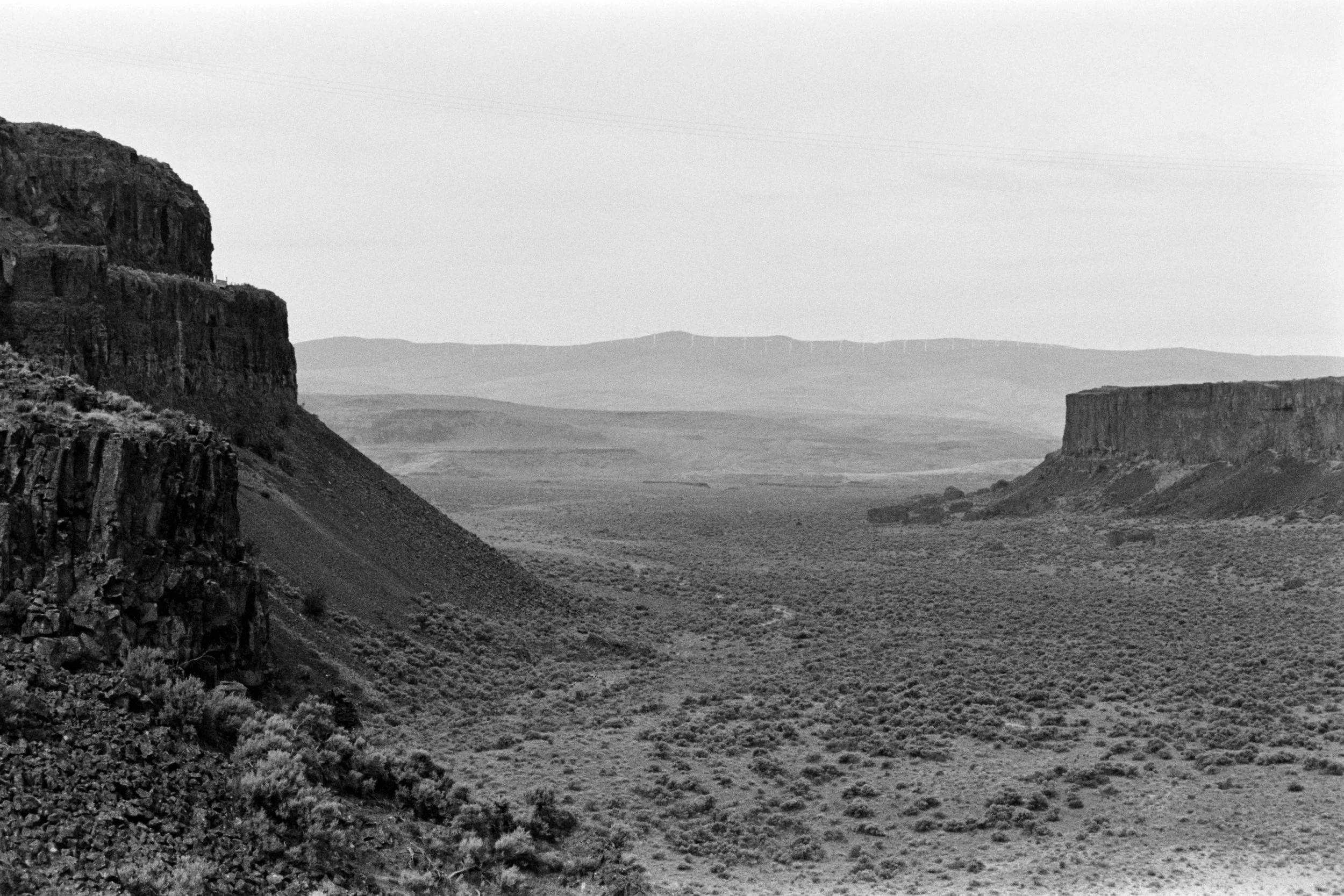
Frenchman Coulee, Washington (135/35mm Kodak Tri-X 400)

If a man's imagination were not so weak, so easily tired, if his capacity for wonder not so limited, he would abandon forever such fantasies of the supernal. He would learn to perceive in water, leaves and silence more than sufficient of the absolute and marvelous, more than enough to console him for the loss of the ancient dreams. — Desert Solitaire by Edward Abbey

Original sin, the true original sin, is the blind destruction for the sake of greed of this natural paradise which lies all around us — if only we were worthy of it. Now when I write of paradise I mean Paradise, not the banal Heaven of the saints. When I write “paradise” I mean not only apple trees and golden women but also scorpions and tarantulas and flies, rattlesnakes and Gila monsters, sandstorms, volcanos and earthquakes, bacteria and bear, cactus, yucca, bladderweed, ocotillo and mesquite, flash floods and quicksand, and yes — disease and death and the rotting of the flesh. — Desert Solitaire by Edward Abbey
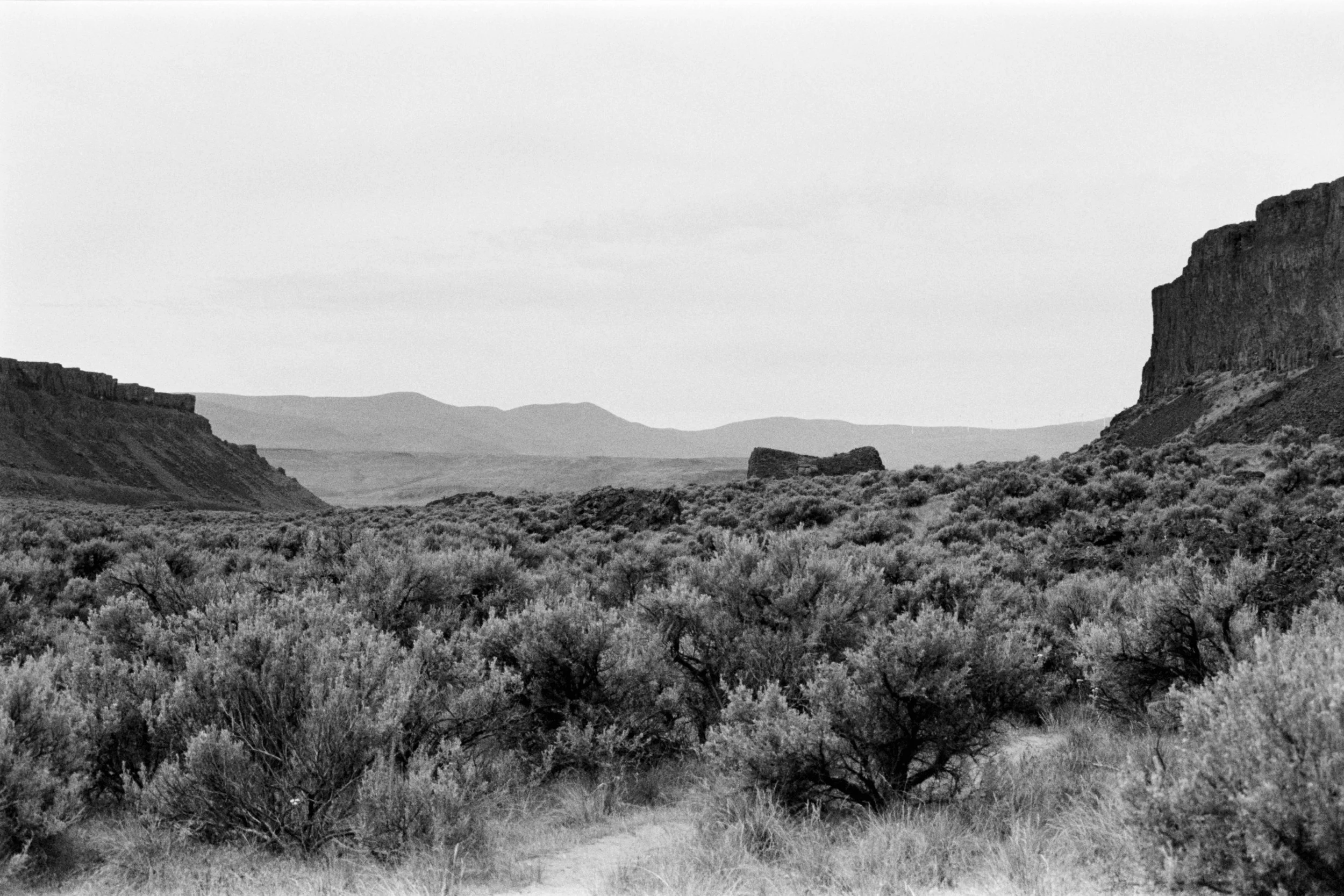
Frenchman Coulee, Washington (135/35mm Kodak Tri-X 400)

So I withdrew and thought to myself: “I am wiser than this man; it is likely that neither of us knows anything worthwhile, but he thinks he knows something when he does not, whereas when I do not know, neither do I think I know; so l am likely to be wiser than he to this small extent, that I do not think I know what I do not know.” — Apology of Socrates by Plato

Frenchman Coulee, Washington (135/35mm Kodak Tri-X 400)

It is no different with the faith with which so many materialistic natural scientists rest content nowadays, the faith in world that is supposed to have its equivalent and its measure in human thought and human valuations — a "world of truth" that can be mastered completely and forever with the aid of our square little reason. What? Do we really want to permit existence to be degraded for us like this — reduced to a mere exercise for a calculator and an indoor diversion for mathematicians? Above all, one should not wish to divest existence of its rich ambiguity: that is a dictate of good taste, gentlemen, the taste of reverence for everything that lies beyond your horizon. That the only justifiable interpretation of the world should be one in which you are justified because one can continue to work and do research scientifically in your sense (you really mean, mechanistically?) — an interpretation that permits counting, calculating, weighing, seeing, and touching, and nothing more — that is a crudity and naiveté, assuming that it is not a mental illness, an idiocy.

Would it not be rather probable that, conversely, precisely the most superficial and external aspect of existence — what is most apparent, its skin and sensualization — would be grasped first — and might even be the only thing that allowed itself to be grasped? A “scientific” interpretation of the world, as you understand it, might therefore still be one of the most stupid of all possible interpretations of the world, meaning that it would be one of the poorest in meaning. This thought is intended for the ears and consciences of our mechanists who nowadays like to pass as philosophers and insist that mechanics is the doctrine of the first and last laws on which all existence must be based as on a ground floor. But an essentially mechanical world would be an essentially meaningless world. Assuming that one estimated the value of a piece of music according to how much of it could be counted, calculated, and expressed in formulas: how absurd would such a “scientific” estimation of music be! What would one have comprehended, understood, grasped of it? Nothing, really nothing of what is “music” in it! — The Gay Science by Friedrich Nietzsche